Ouchi-juku Hange Festival

Ouchi-juku Hange Festival

Held every year on July 2, the Ouchi-juku Hange Matsuri (‘mid-summer festival’) is a charming festival with hundreds of years of tradition behind it. The festival takes place at the traditional Edo period post town of Ouchi-juku, about 40 minutes south of Aizu-Wakamatsu City. It features a vivid parade featuring men in black eboshi caps carrying around the mikoshi (portable shrine), as well as the famous red-faced Tengu, supernatural creatures seen as spiritual guardians.

Originally held to venerate the spirit of Prince Mochihito, an emperor’s son said to have taken refuge here after the Genpei War, the festival is now a broader community event that prays for household safety and strong harvests.

Blessings are invoked at 12:00pm at Takakura Shrine, with the parade starting from 12.30pm and winding its way slowly through the village until about 3pm. They take breaks at several points, so it’s even possible to duck into a nearby soba restaurant for lunch. (A great time to try negi-soba, the Ouchi-juku speciality of soba eaten with a long onion!)  

Venue Details

Venue Details
Best Season
  • Summer
Estimated Visit Time2h
Parking500 yen for regular cars; up to 3,000 yen for large buses
Entrance FeeFree entry to the village
Access Details
AccessYamamoto, Ouchi, Shimogo Town, Minamiaizu District, Fukushima Pref. 969-5207
View directions
Getting there

By Car: 75 min from Shirakawa I.C. exit off the Tohoku Expressway. (Or 50 min from central Aizu-Wakamatsu City)

By Train: 15 min by taxi or bus from Yunokami Onsen Station

Mapcode for Car GPS: 433 583 290*64

Useful Links

Getting to Ouchi-juku [Detailed Access Information]

Ouchi-juku Gourmet Tour Model Itinerary

Visiting the Ouchi-juku Snow Festival

Ouchi-juku Snow Festival Information

Ouchi-juku Kimono Experience

Mountain and Travel Course Guide [Going from the Old Village of Ouchi-juku to a Beech Tree Forest in Mt. Onodake]

Fukushima Festival Guide

Nearby

The World Glassware Hall
Cultural Experiences

Mori no Bunko Fuzawa

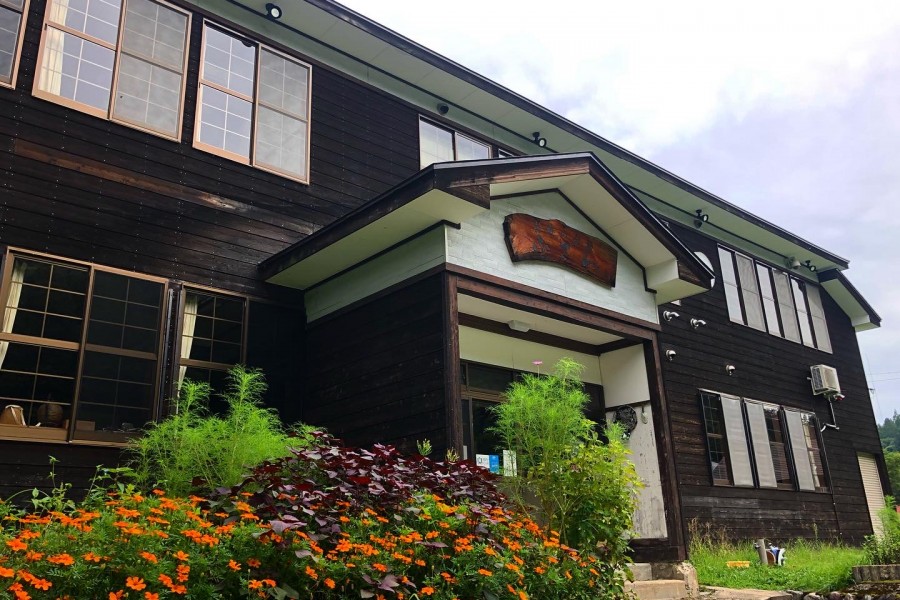
Mori no Bunko Fuzawa is a mountain village life workshop facility where guests can experience the lifestyle, nature, and charms of living in a Japanese rural mountain village. [photo id="wedA3wsHghGka5MbrORGYjRkj8BGAinlLCOG5O0L.jpg"] This building was a working school up to 40 years ago, the black board in one classroom where all of the students wrote their goodbye messages on the last day of school has been preserved as is. (If you visit, please be sure to avoid touching, erasing, or writing on the black board.) [photo id="fNNbYszCkKk3qvw1ozp5lY5yn8UDJPkrsrHf05Jf.jpg"] All three classrooms are available to stay the night in! Guests are charged per person, not per room, so if your group are the only ones staying the night then you are free to spread out into all three of the rooms. This is the kind of lodging that Japanese students would stay in on overnight school trips, so there is a sense of nostalgia when staying here.  There are also many different activities that you can experience when staying here, such as local and traditional craft making and even river trekking with local guides! Read more about river trekking experiences here. [photo id="YrRrT5cHuDe3wK75RWrxgat8d8JPQP9P7bQgJwuY.jpg"]

The World Glassware Hall
Cultural Experiences

Makie Painting at Suzutake Workshop

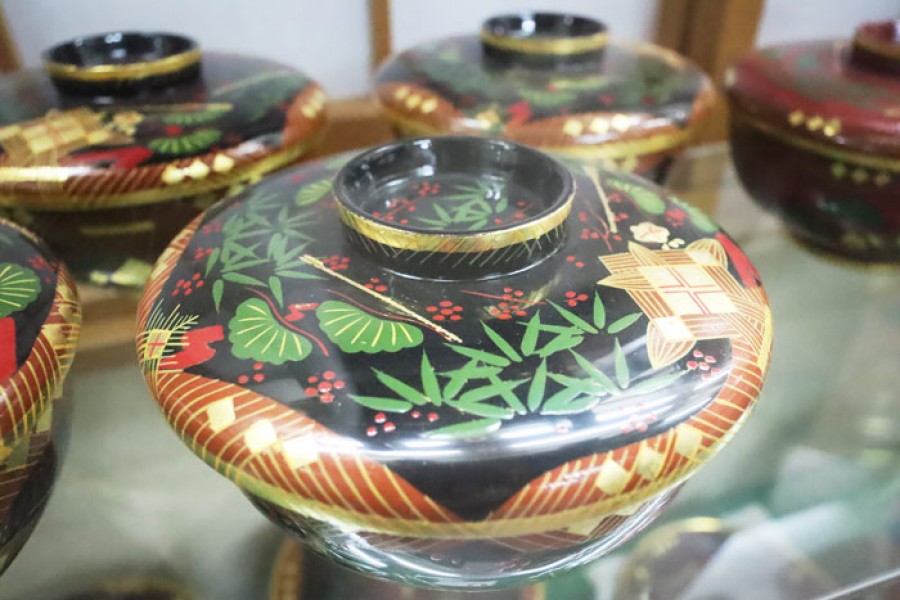
Suzutake workshop tours began in the 1950s as a way of providing families with a chance to learn about the history and artistry of lacquerware. Even today, visitors are able to actually see artisans at work at three key stages of the Aizu lacquerware making process: 1) applying a base layer of unrefined lacquer or astringent liquid to wood; 2) adding additional layers of lacquer in a desired style, and 3) adding hand-drawn delicate designs ('makie') using either colored lacquer or gold and silver power (a technique called 'Sunken gold makie'). Visitors can also take part in a makie-painting experience.

The World Glassware Hall
Cultural Experiences

Paint Your Own Akabeko

Bookings for the akabeko painting can be made on the official reservation page.What is 'Akabeko'?The akabeko legend started at Enzoji Temple in Yanaizu Town, in the Aizu region. The construction of this temple began in the year 807, but due to a huge earthquake at the end of the seventeenth century, it had to be repaired in 1617. It was during the reconstruction of the temple that the akabeko became a folk legend.It is said that moving the wood and other supplies necessary for the reconstruction work was incredibly difficult because materials had to be transported from various villages upstream of the Tadami River. The materials were heavy and the journey to the temple was long. Cattle were used to transport materials, but many struggled to bear their loads.Then, out of nowhere, appeared a cow with a red coat. (It should be noted that, in the past, the word ‘red’ was used to describe the color ‘brown’, so it is likely that it was a brown cow.) The red cow supported the other cows and helped the priests who were constructing the temple until it was completed. Then, it suddenly vanished.'Akabeko' means 'red cow' in the local dialect.A number of statues of the cow were built inside the temple grounds so that the people of Yanaizu could express their gratitude to the akabeko.In the years following, there was a range of legends about the akabeko, with stories such as families who owned akabeko being rid of sickness upon stroking the cows. They continued to hold their status of bringers of good luck and strength. Families bought or made akabeko toys for their young children to play with.Akabeko Painting ExperiencesIn recent history, the Aizu tradition of painting akabeko began. It is said that this tradition started as something to do for children visiting Aizu-Wakamatsu City as part of school trips. This was when the story of the Akabeko evolved once more, into its newest papier-mâché form. The stripes on the face and back of the papier-mâché Akabeko are said to represent strength and perseverance.There are a number of workshops in Aizu-Wakamatsu City where you can paint your own Akabeko. Most workshops offer the standard red, white, and black paint. These talismans for good health make very cute and lightweight souvenirs to take home for family and friends – or keep for yourself! Those who prefer to buy a ready-painted Akabeko will be able to find it at most souvenir shops.BookingIf you would like to book an akabeko painting experience at the Tsurugajo Kaikan (a shopping complex located next to Tsurugajo Castle), please access this page.

You might also like

Higashiyama Onsen Candle Festival
Events & Festivals

Higashiyama Onsen Candle Festival

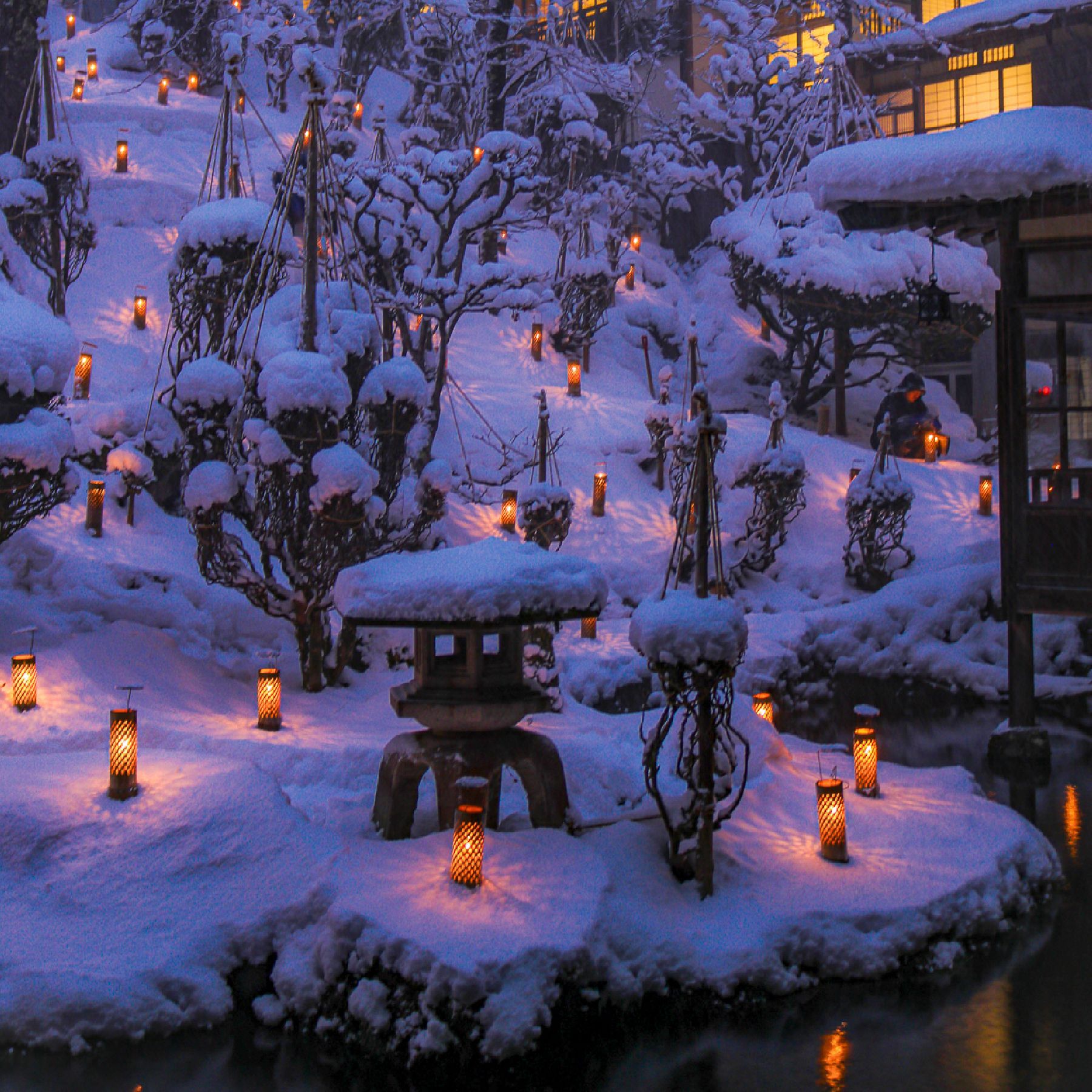
The Candle Festival at Higashiyama Onsen runs for three months from mid-December through to the end of February. The candles in this charming onsen town are illuminated for 90 minutes every evening, making for a pleasant atmosphere on an evening stroll.The festival begins on 21 December and continues until 28 February in winter 2024/25. Candles are lit 16:30-18:00 in December and January, 17:00-18:30 in February.Given its dates, the Candle Festival combines well with visiting other winter festivals, regardless of whether you’re staying in Higashiyama Onsen.

Aizu Festival
Events & Festivals

Aizu Festival

The Aizu Festival is the biggest event of the year for the historic Aizu region. The main feature of the festival is the Aizu Hanko Gyoretsu, a procession of Aizu Domain lords and samurai.Headed by flag-bearers holding the standards of the feudal lords of the Aizu Domain, the procession is attended by participants representing well-known feudal lords such as Lord Uesugi, Lord Hoshina, and Lord Matsudaira, and by groups of festival participants wearing garments and carrying tools associated with each of these lords.Each year, some 500 people parade through downtown Aizu-Wakamatsu in an event that magnificently recreates the world of samurai. Before the procession starts off, there is a kick-off ceremony at Tsurugajo Castle.Visitors can enjoy watching the sword dancing of the Byakkotai warriors and sword fight performances given by professional actors, with the castle keep of Tsurugajo in the background.Overseas visitors or Japan residents can also join the parade in samurai armour; for more details about joining the 2026 parade next year, please send us an email.2025 Festival Schedule:Full details of the 2025 schedule here (in English).Full details of the 2025 schedule here (in Japanese).19 September 2025 (Friday)18:00 - 18:30 Lantern parade: Local schoolchildren will walk from Tsurugajo Castle to Shinmei Street carrying lanterns.19:00 - 20:30 Aizu-Bandaisan Mountain Dance: Held around a tower set up on Shinmei Street. Anyone is free to join in.Main day: 20 September 2025 (Saturday)09:55 Lord's Procession: The procession leaves from Tsurugajo Castle and carries on through the city, ending at roughly 1pm or 2pm. More events are held at the castle and around the city; please check the above English pamphlet for more details.19:00 - 20:30 Aizu-Bandaisan Mountain Dance: Held around the tower on Shinmei Street. Anyone is free to join in.21 September 2025 (Sunday)10:00 Nisshinkan Children's Parade: Children march through the streets dressed as members of the legendary Byakkotai (White Tiger Corps) or Swords Corps.10:10 Drum and Flute Corps Parade: Students from around 20 elementary schools in the city perform with traditional drum and flute.

Lake Numazawa Festival
Events & Festivals

Lake Numazawa Festival

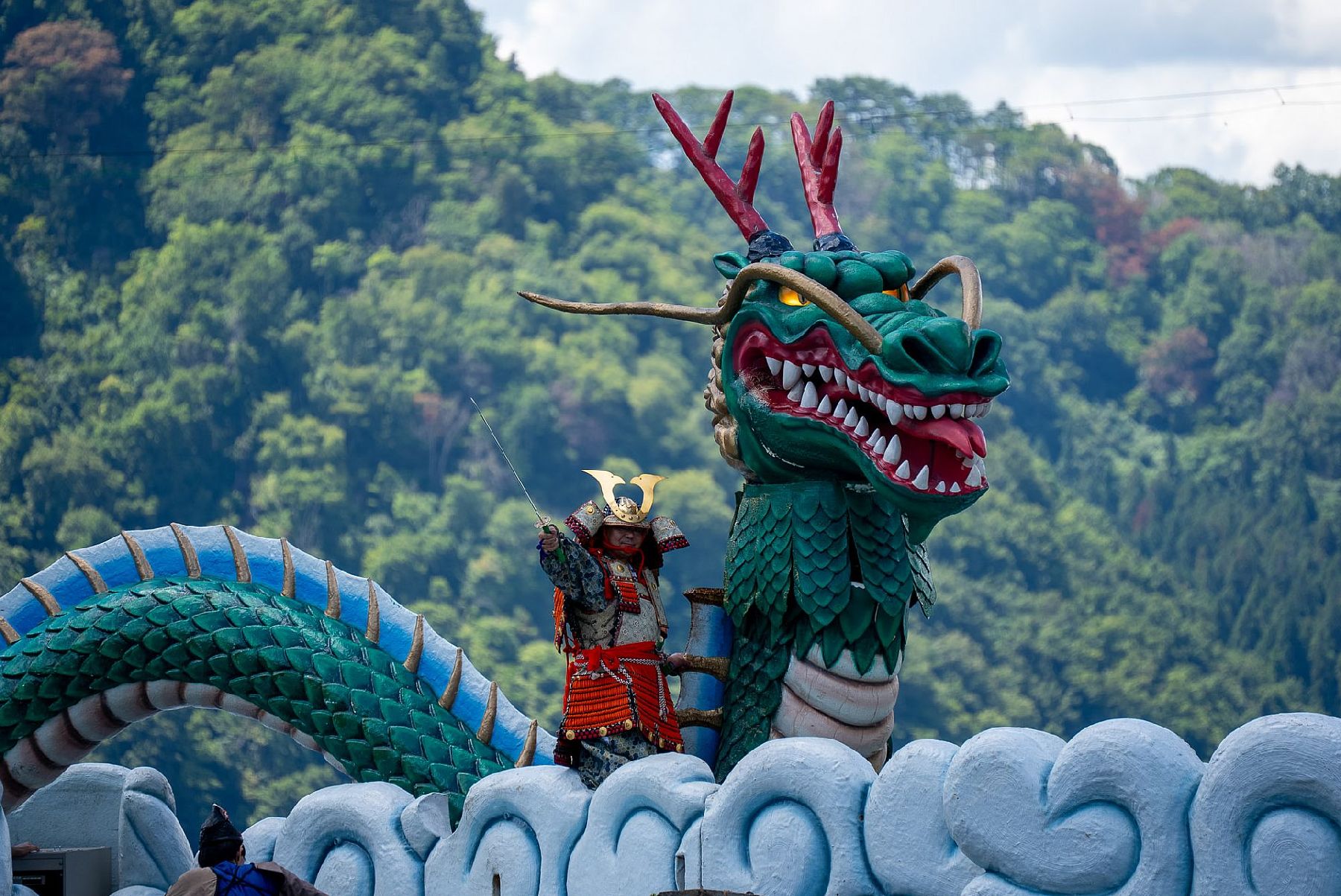
Lake Numazawa Festival is held on the first Saturday and Sunday of August every year at Lake Numazawa in Kaneyama Town. It is said that over 800 years ago, a man killed a giant snake (dragon) that lived at the bottom of Lake Numazawa in order to protect Kaneyama Town. Over the course of the 2 days, local people act out this folktale at the lakeside. Come and visit to enjoy some local shows, watch firework displays on the Saturday night, and swim in the lake!As a rough framework, fireworks typically launch around 8pm on the Saturday night, coinciding with the arrival of the great snake, and the samurai warriors arrive to perform around 12pm (noon) on the Sunday.Visitors arriving by car should park according to instructions from staff in the large auxiliary car park - this is close enough to the lake to be a short walk, but shuttle buses also run regularly between the two locations, the journey taking about 2-3mins.

Otawara Hiki (Bale Pulling Festival)
Events & Festivals

Otawara Hiki (Bale Pulling Festival)

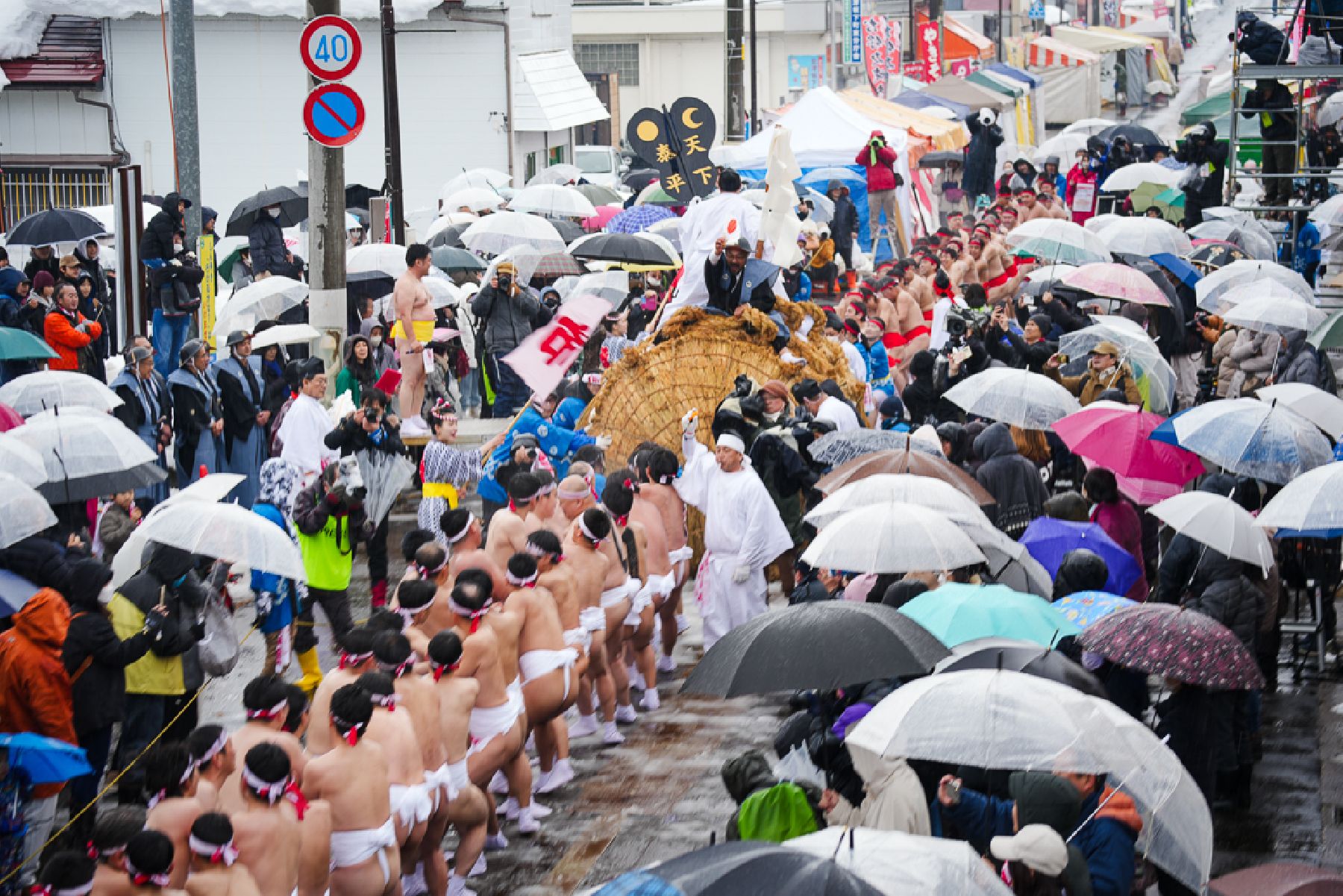
Held in the town of Aizu-Bange to the northwest of Aizu-Wakamatsu City, Otawara Hiki is a fierce display of community spirit and competitive energy that traces its roots back to the Edo period. It's the main attraction of the so-called 'Strange Festival', which takes place on 14 January every year.There is a children's event, featuring local students, before the main bout is fought over a large bale between teams representing the west (the white team) and the east (the red team). Despite the cold, the male participants take part largely in loincloths, while female participants wear a traditional festival light coat. It's said that if the east team wins, business will prosper in the coming year, while if the west team wins, it means there will be a bountiful harvest.The festival was first founded over 400 years ago in the Warring States Period, but was abolished by the Imperial government after the Aizu Domain's loss under the shogun in the Boshin War (civil war) of 1868. The tradition was restarted roughly a century later in 1956, and has continued to this day.Before the tug-of-war, there are taiko drum performances, and afterwards visitors can enjoy a dramatic display of the pounding of mochi by local experts, cheered on by the crowd, and receive a miniature bale said to bring good luck.Members of the public can also join the tug-of-war if they apply in advance. Please contact us for more details.A similar Strange Festival takes place in nearby Aizu-Misato on 11 January, also featuring a tug-of-war over a large bale, albeit wearing more layers than their counterparts in Aizu-Bange.

Top